


Table of Contents
- What Is a Business Continuity Plan?
- Business Continuity Plan vs. Disaster Recovery Plan
- Why Small Businesses Need a Business Continuity Plan
- How to Build a Business Continuity Plan
- What to Include in Your Business Continuity Plan Document
- Common Mistakes That Undermine a Business Continuity Plan
- Where an IT Partner Fits Into Your Business Continuity Plan
- How Often Should You Update Your Business Continuity Plan?
- FAQs
A single afternoon without email, phones, or your point-of-sale system can cost a small business thousands of dollars and a chunk of customer trust. A business continuity plan is what keeps operations running, or gets them running again fast, when something disrupts your business: a ransomware attack, a power outage, a burst pipe, or a key employee out for weeks. Research from the U.S. Chamber of Commerce Foundation found that only about 26% of small businesses actually have one in place, even though most believe they're prepared.
This guide walks through what a business continuity plan covers, how to build one step by step, and how it fits alongside your IT infrastructure and disaster recovery plan.
Key Takeaways
- A business continuity plan keeps critical operations running during and after a disruption. A disaster recovery plan restores the technology behind them. You need both.
- Building one starts with identifying which functions your business cannot survive without, then a business impact analysis to prioritize them.
- A complete plan documents recovery strategies, communication procedures, and clear roles, not just a list of risks.
- An untested plan fails when you need it most. Review and test it at least once a year.
- If you already run managed backups and monitored infrastructure, you have a head start on the technical half of continuity planning.
What Is a Business Continuity Plan?
A business continuity plan (BCP) is a documented strategy that explains how your company keeps operating, or resumes operating quickly, during and after an event that disrupts normal business. That event could be a cyberattack, a fire, a supply chain failure, a regional power outage, or something as ordinary as your office building losing internet for two days.
A BCP is broader than an emergency evacuation plan or a data backup routine. It covers people, processes, vendors, and communication, not just technology. It names who does what, defines which functions matter most, and sets out the steps to keep revenue-generating work moving even when your normal setup is unavailable.
Every business benefits from having one, but some are required to. Financial firms, for example, must maintain a continuity plan under FINRA Rule 4370. Law firms, healthcare practices, and other regulated industries often face similar client or compliance expectations, even without a specific rule naming them.
A useful way to think about scope: a solo consultant's plan might fit on two pages and cover a laptop failure and a lost internet connection. A twenty-person office with multiple locations needs a plan that accounts for staff coverage, vendor coordination, and several possible points of failure at once. The format scales with the business, but the underlying questions stay the same.
Business Continuity Plan vs. Disaster Recovery Plan
These two terms get used interchangeably, but they answer different questions.
- A business continuity plan asks: how does the business keep functioning? It covers staff roles, customer communication, vendor backups, and alternate ways of working across the whole organization.
- A disaster recovery plan asks: how do we get our systems and data back? It's narrower and IT-focused, covering backup restoration, failover infrastructure, and the specific technical steps to bring servers, applications, and data back online.
Think of disaster recovery as one component that feeds into the larger continuity plan. If a server crashes, your DR plan gets the data back; your BCP determines who tells customers what's happening in the meantime and whether staff can keep working from a backup system while recovery is underway. Our guide on how to test your disaster recovery plan covers that technical side in more detail.
Why Small Businesses Need a Business Continuity Plan
Small businesses are more exposed to disruption than larger companies, not less. They typically run on thinner margins, rely on fewer people to cover critical functions, and can't absorb a week of lost revenue the way an enterprise can. Roughly 40% of businesses that experience a major disaster never reopen, and another 25% close within the following year.
A continuity plan changes those odds. Specific benefits include:
- Less downtime, less lost revenue. Clear procedures mean less time spent figuring out what to do and more time spent doing it.
- Stronger customer trust. A dental office that can text patients about a schedule change during an outage looks far more reliable than one that goes silent.
- Fewer compliance headaches. Many client contracts and industry regulations now expect a documented continuity plan, not just a promise that "we'll figure it out."
- Better insurance outcomes. Insurers increasingly ask about continuity planning when underwriting cyber and business interruption policies, and a documented plan can affect your rate.
- Steadier staff. Employees who know their role during a crisis are calmer and more effective than those improvising.
How to Build a Business Continuity Plan
A continuity plan is best built as a team effort. Involve whoever actually runs day-to-day operations, not just leadership, since they're the ones who know where the real dependencies sit.
1. Identify Your Critical Business Functions
Start with a hard question: if operations stopped tomorrow, what has to keep running within the first 48 hours for the business to survive? For a real estate office, that might be transaction processing and client communication. For a law firm, it's likely case management access and court filing deadlines.
List every activity that touches revenue, customer service, payroll, or legal obligations. This list becomes the backbone of everything else in the plan.
2. Conduct a Business Impact Analysis
A business impact analysis (BIA) scores each critical function so you know what to restore first. For each one, estimate:
- Maximum allowable downtime: how many hours or days the function can be unavailable before serious harm sets in.
- Financial impact: what an hour or day of downtime costs in lost revenue or billable time.
- Customer impact: whether clients notice immediately or the delay is invisible to them.
- Legal and compliance impact: whether a delay breaches a contract, a filing deadline, or a data protection obligation.
Two numbers come out of this exercise that shape everything downstream: your recovery time objective (RTO), the maximum time a system can be down, and your recovery point objective (RPO), how much data loss is acceptable, measured in time since the last good backup.
3. Assess and Prioritize Risks
Not every business faces the same threats. A Southern California office should weight wildfire and earthquake risk more heavily than a Midwest business would, while every business regardless of location needs to plan for cyberattacks, power outages, and equipment failure. Rank each risk by likelihood and by how much damage it would cause, then focus your planning effort on the top of that list rather than trying to cover every hypothetical equally.
A useful exercise here is walking through your last few actual disruptions, not hypothetical ones. If your office lost power for six hours last year, or a vendor missed a delivery deadline, those are proven risks, not guesses, and they belong near the top of your list.
4. Build Recovery and Prevention Strategies
For each major risk, decide what keeps the business running. This might mean a secondary internet connection, an alternate work location, a backup payment processor, or a service level agreement with a key vendor that guarantees a response time. The goal is redundancy: if the normal way of doing something breaks, there's already a fallback in place rather than one improvised under pressure.
5. Document Roles, Responsibilities, and Response Procedures
Write down who does what when the plan activates. Assign a person (and a backup for that person) to each responsibility: who declares an emergency, who contacts vendors, who manages finances during the disruption, who talks to customers. Include the first-hour actions for your highest-impact scenarios so nobody has to think from scratch during the actual event.
6. Create a Communication Plan
Disruptions create confusion fast, and confusion is worse when your normal communication tools (email, phone system) are part of what's down. Document backup contact methods for staff, customers, and vendors, keep an updated contact list somewhere accessible offline, and prepare basic message templates in advance so nobody is drafting a client email from scratch during a crisis.
7. Test, Train, and Update the Plan Regularly
A plan nobody has practiced is a plan that fails under pressure. Run a tabletop exercise at least once a year: walk through a specific scenario, like a ransomware attack locking your file server, and confirm every person knows their role. Update the plan whenever your systems, staff, or vendors change significantly, not just on an annual schedule.
What to Include in Your Business Continuity Plan Document
Once you've worked through the steps above, the plan itself should be a single reference document, not scattered notes. A complete BCP typically includes:
- Purpose and scope: what the plan covers and which locations, teams, or systems it applies to.
- The critical function list and BIA results from steps 1 and 2.
- Recovery time and recovery point objectives for key systems.
- Response procedures for each major risk scenario identified in step 3.
- The communication plan and full contact list.
- Backup and technology recovery details, including where backups live and how to restore them.
- Roles, responsibilities, and a leadership succession outline in case a decision-maker is unavailable.
- A testing and review schedule.
Keep both a digital and a printed copy. If the disruption is a network or power outage, a plan that only exists on the affected server does you no good.

Common Mistakes That Undermine a Business Continuity Plan
A lot of continuity plans look complete on paper and fail the moment they're actually needed. Watch for these gaps:
- Treating it as a one-time project. A plan written two years ago and never revisited rarely matches your current systems, vendors, or staff.
- Skipping the test. Assuming backups work because nobody has checked is the single most common failure point. Test the actual restore, not just the backup job status.
- Putting the whole plan on one person's laptop. If that person is the one who's unreachable during the emergency, the plan is useless. Store it somewhere multiple people can access, offline if needed.
- Ignoring vendor dependencies. A plan that covers your own systems but not your payment processor, your primary supplier, or your internet provider has a gap that will show up eventually.
- No defined trigger. If nobody knows exactly when the plan activates, it activates too late. Define clear thresholds in advance.
Where an IT Partner Fits Into Your Business Continuity Plan
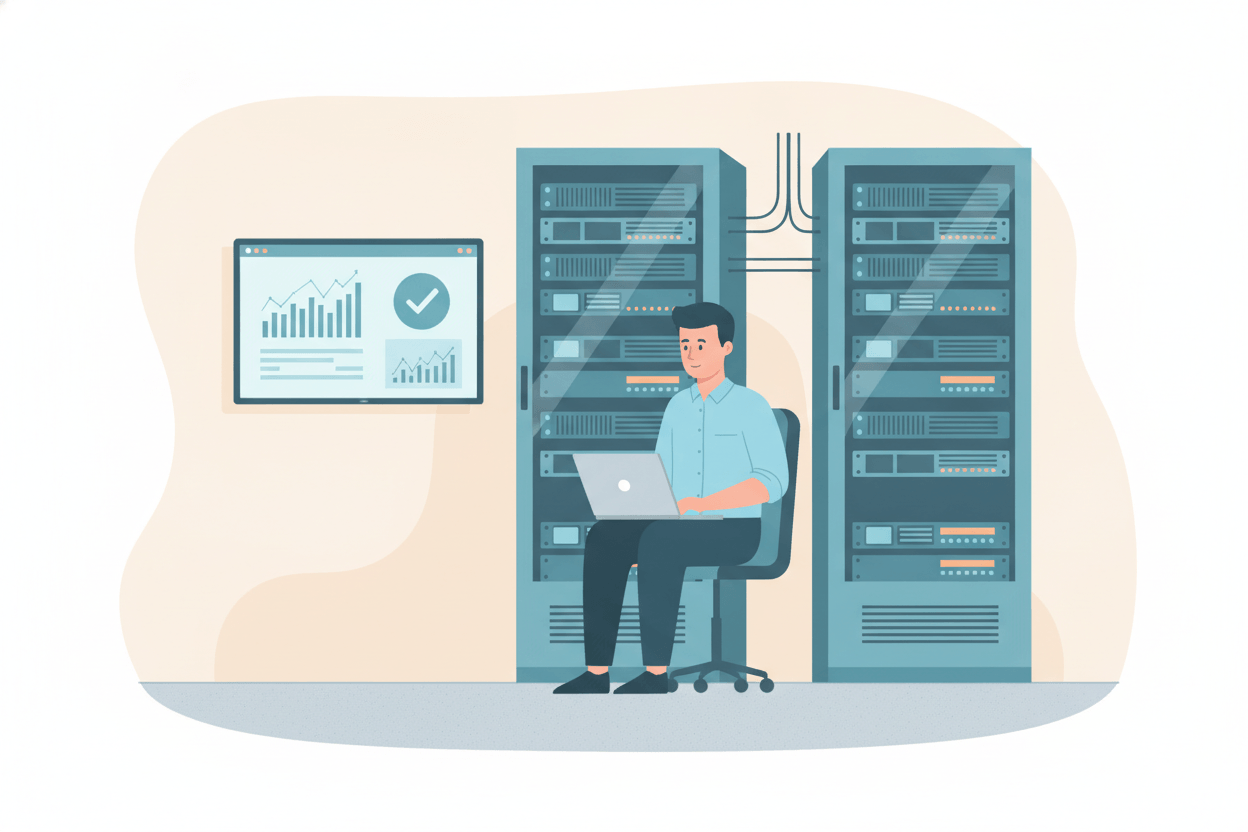
Most of what makes a continuity plan work in practice depends on infrastructure decisions that are easy to overlook until they're tested by an actual outage. Automated, monitored backups matter more than the backup software you happen to be running. A tested restore process matters more than an assumption that backups "probably work." Redundant internet and cloud failover matter more than a paper plan that says "switch to backup internet" with no backup connection actually configured.
This is where managed IT support does more than fix the occasional printer problem. A managed provider handles the technical half of your continuity plan continuously: verified backups, 24/7 monitoring that catches a failing server before it takes down operations, and a documented recovery process that's actually been tested rather than assumed. Our backup and disaster recovery solutions guide covers what that looks like on the technology side, and our data backup and disaster recovery services page has details on how we structure that support for clients.
None of this replaces the people-and-process side of a BCP. But if the technology underneath your plan isn't solid, the rest of the document is aspirational rather than actionable.
How Often Should You Update Your Business Continuity Plan?
Review your business continuity plan at least once a year, and update it any time something material changes: new software, a new office location, a new key vendor, or significant staff turnover in a role with continuity responsibilities. Run a tabletop exercise on the same schedule. Treat the annual review as a floor, not a ceiling. A fast-growing business that added a location or a new line of business mid-year shouldn't wait until the calendar date to revisit its plan.
Pair this with the kind of proactive IT maintenance covered in our preventive IT maintenance checklist, since a lot of what a continuity plan protects against is exactly the kind of slow-building failure regular maintenance catches early.
For a quick five-minute overview of the core concept, this explainer video is a useful primer before diving into the planning steps above.

Building a business continuity plan takes real time up front, but it's far cheaper than the alternative. Most businesses that go through the process find the biggest surprise isn't a new risk they hadn't considered. It's discovering how many "we'll figure it out" assumptions were quietly sitting underneath their day-to-day operations. If you'd rather have someone walk through the technical side of your plan with you, a consultation is a low-pressure way to see where the gaps are.
FAQs
What are the 5 components of a business continuity plan?
Most plans include: a purpose and scope statement, a list of critical business functions with a business impact analysis, recovery time and recovery point objectives, documented response and communication procedures, and a testing and maintenance schedule. Larger organizations often add a leadership succession plan and vendor dependency mapping as well.
What does a business continuity plan include?
A complete plan documents your critical functions, the risks most likely to disrupt them, recovery strategies for each risk, clear roles and responsibilities, a communication plan for staff and customers, and details on backup and technology recovery. It should be a single reference document, kept both digitally and in print.
What are examples of a business continuity plan?
A law firm's plan might cover working from a backup case management system during an outage and notifying courts of filing delays. A dental office's plan might include a backup scheduling system and a patient text-message alert process. A retail business might plan around a secondary payment processor and an alternate internet connection.
What are the steps in business continuity plan management?
The core steps are: identify critical business functions, conduct a business impact analysis, assess and prioritize risks, build recovery and prevention strategies, document roles and response procedures, create a communication plan, and test and update the plan on a regular schedule.
How often should you update a business continuity plan?
Review and test your plan at least once a year. Update it sooner any time something material changes, such as new software, a new office location, a new key vendor, or significant staff turnover in a role with continuity responsibilities.