

Table of Contents
- What Are 24/7 Managed Security Services?
- Why SMBs Need 24/7 Managed Security Services
- Core Components of a Managed Security Service
- How Managed Security Services Work in Practice
- Implementation Timeline and Realistic Expectations
- Managed Security Services vs. Traditional MSP Cybersecurity Offerings
- Conclusion
Small and mid-sized businesses face a cybersecurity crisis: 56% of SMBs experienced a cyberattack in the past year, yet most lack the budget or expertise to build internal security teams. A data breach costs the average SMB $4.8 million and forces 60% of affected businesses to close within six months. The gap between threats and defenses is widening, but there's a proven solution that doesn't require hiring expensive security staff. 24/7 managed security services deliver enterprise-grade threat detection in hours rather than the 277 days internal teams typically take to spot a breach. This guide explains what managed security services are, why they matter to your business, and how they work in practice.
Key Takeaways
- SMBs spend $29.8 billion annually on managed security services, with 65% of SMBs now using some form of outsourced security (2025)
- 24/7 managed security services detect 90% of threats within hours versus average internal detection time of 277 days
- A data breach costs the average SMB $4.8 million, making outsourced security 60% cheaper than building an internal team
- What Are Managed Security Services: Third-party providers monitor your systems 24/7, detect threats in hours, and handle incident response without requiring in-house security staff.
- Why Detection Speed Matters: The faster threats are found, the less damage they cause; managed services compress detection time from months to hours.
- Managed SOC vs. Break-Fix Support: Managed security includes proactive 24/7 monitoring, automated alerts, and response workflows—not just reactive ticket-based support.
- Core Security Components: Most managed services cover network monitoring, endpoint protection, firewall management, threat hunting, and compliance reporting.
- Cost vs. In-House Reality: Managed services cost 40-60% less than hiring and retaining a full-time security team.
- Implementation Timeline: Deployment typically takes 2-4 weeks depending on infrastructure complexity and integration requirements.
What Are 24/7 Managed Security Services?
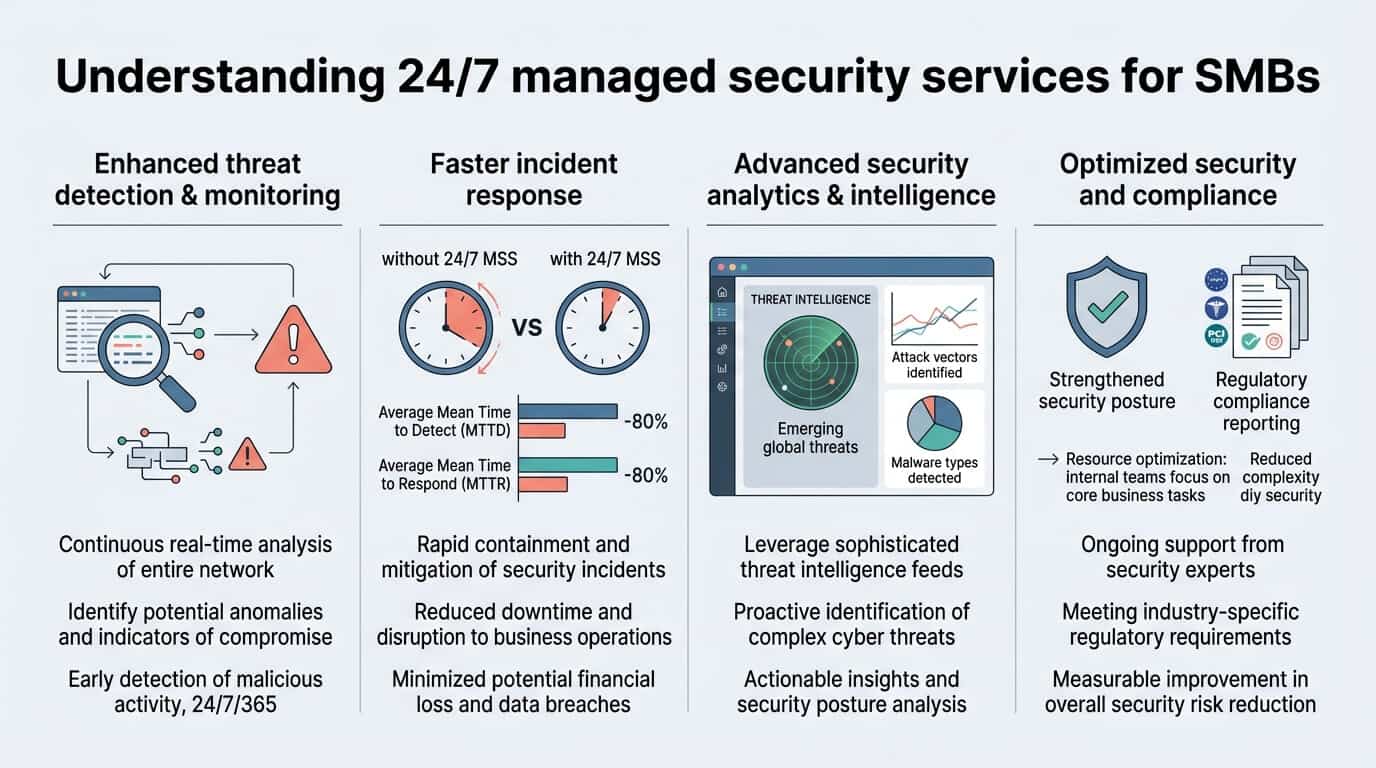
24/7 managed security services deliver continuous, expert-led threat monitoring and incident response without requiring a full in-house security team. A managed security service provider (MSSP) operates a Security Operations Center (SOC) that watches your networks, endpoints, and infrastructure around the clock. When threats are detected, the MSSP's analysts investigate, contain, and remediate the threat while keeping you informed every step of the way.
The Core Function: Detection, Analysis, and Response
At its foundation, managed security is about compression. Instead of your small IT team scrambling to detect and handle threats during business hours, an MSSP's experts do it continuously. The service combines human expertise with AI-driven detection tools to identify anomalies, suspicious patterns, and known threat signatures the moment they appear. When a threat is detected, the MSSP investigates to confirm it's genuine (reducing false alarms), escalates it if necessary, and initiates containment. For SMBs, this means threats that internal teams might miss for months are caught and resolved in hours.
"The difference between a breach that costs $100,000 to contain and one that costs $4.8 million is often just hours of detection time. Managed security services compress that timeline from months to minutes."
Most services operate on a tiered escalation model. Lower-priority alerts are logged and summarized in daily reports. Medium-priority events trigger analyst investigation and may result in automated containment. Critical threats initiate immediate phone contact and hands-on response. This structure ensures your business doesn't get overwhelmed by false alarms while critical issues get the urgent attention they deserve.
How 24/7 Coverage Differs from Business Hours Support
Traditional IT support operates during your business hours, typically 9 AM to 5 PM. Threats don't follow a schedule. A ransomware attack at 2 AM on Saturday reaches full encryption before anyone notices. Managed security services operate on your attackers' schedule, not your office hours. A dedicated team is always monitoring, and security automation handles immediate containment without waiting for humans to log in.
This constant vigilance eliminates the dwell time—the window of time a threat sits in your network undetected. According to industry research on managed security benefits, internal teams take an average of 277 days to discover a breach, but managed MSSPs spot 90% of threats within hours. For SMBs without dedicated security staff, the difference between detection in days versus months is often the difference between a contained incident and a catastrophic breach.
Managed Security vs. Traditional Break-Fix IT Support
Break-fix IT support is reactive: something breaks, you call, a technician fixes it. Security threats are different. They rarely announce themselves as "broken." A managed security service is proactive and continuous—like having a security guard on patrol versus calling the police after a robbery. Managed security providers monitor for early warning signs, patch vulnerabilities before they're exploited, hunt for suspicious activity, and respond to threats automatically.
Many SMBs pair managed IT support with managed security because they serve different needs. Proactive IT maintenance handles system updates and hardware health; managed security handles threat detection and incident response. The two complement each other but require different expertise and vigilance.
Why SMBs Need 24/7 Managed Security Services
SMBs are simultaneously the most vulnerable and least prepared for cybersecurity threats. According to Connectwise's analysis of SMB cybersecurity trends, cybercriminals target small businesses at nearly four times the rate of large enterprises, yet SMBs have less budget, fewer skilled staff, and less specialized knowledge to defend themselves. This is the vulnerability gap that managed security fills.
The Economics of Breach Prevention
The financial math is straightforward. Hiring a full-time security analyst costs $70,000–$150,000 annually in salary alone, plus benefits, equipment, and training. You'd need at least two analysts to provide 24/7 coverage, pushing costs to $200,000+ per year. A managed security service typically costs $3,000–$10,000 per month depending on the breadth of service and your infrastructure size—putting the annual investment in the $36,000–$120,000 range for enterprise-grade 24/7 monitoring.
"A managed security service at $5,000 per month sounds expensive until you realize a single breach costs the average SMB $4.8 million. Even if managed security reduces your breach risk by just 10%, the ROI is immediate and substantial."
More importantly, a breach damages the business far beyond the direct costs. Research from Antivirus Insider on managed security statistics shows the average SMB breach costs $4.8 million, which includes forensic investigation, notifications, regulatory fines, legal fees, and reputational damage. 60% of affected SMBs close within six months of a significant breach. Managed security services reduce breach probability dramatically by catching threats before they escalate. For most SMBs, outsourced security is both cheaper and more effective than hiring staff who lack the depth of experience to handle sophisticated attacks.
The Talent Gap in Cybersecurity
SMBs can't compete with large enterprises for security talent. The best analysts gravitate toward companies offering six-figure salaries, interesting projects, and career development. An SMB offering $100,000 gets someone's third choice, not their first. A managed MSSP pools talent across hundreds of clients. Each analyst gains exposure to diverse threats, industries, and attack patterns. They gain more experience in a year than most in-house employees would gain in five.
Additionally, cybersecurity is a rapidly evolving field. New threats emerge constantly. Managed providers invest heavily in threat intelligence, employee training, and tool updates because their entire business depends on staying ahead of attackers. SMBs often can't afford that investment independently.
Key reasons SMBs struggle with internal security teams:
- Salary competition with larger enterprises for top security talent
- Rapid threat evolution requiring continuous learning and tool updates
- Need for 24/7 coverage requiring multiple full-time employees
- Specialized expertise (threat hunting, forensics, compliance) difficult to hire for small teams
- High turnover when talented analysts move to larger companies
Compliance and Regulatory Requirements
Many SMBs are required by law, regulation, or customer contracts to maintain specific security controls. Healthcare providers must comply with HIPAA. Financial firms need PCI DSS compliance. Retailers handling credit cards face payment card industry requirements. Managed security services include compliance monitoring and reporting. The MSSP's team knows what your industry requires and builds monitoring and controls to meet those standards. Without managed security, compliance becomes a guessing game for small IT teams.
Compliance requirements by industry:
- Healthcare (HIPAA): Encryption, access controls, audit logs, breach notification within 60 days
- Finance (PCI DSS): Network segmentation, vulnerability management, penetration testing, compliance audits
- Retail (PCI DSS): Cardholder data protection, secure payment processing, transaction monitoring
- Legal (various): Client data protection, attorney-client privilege safeguards, litigation readiness
- Government contractors (NIST/CMMC): Cybersecurity maturity requirements, controlled unclassified information protection
Core Components of a Managed Security Service
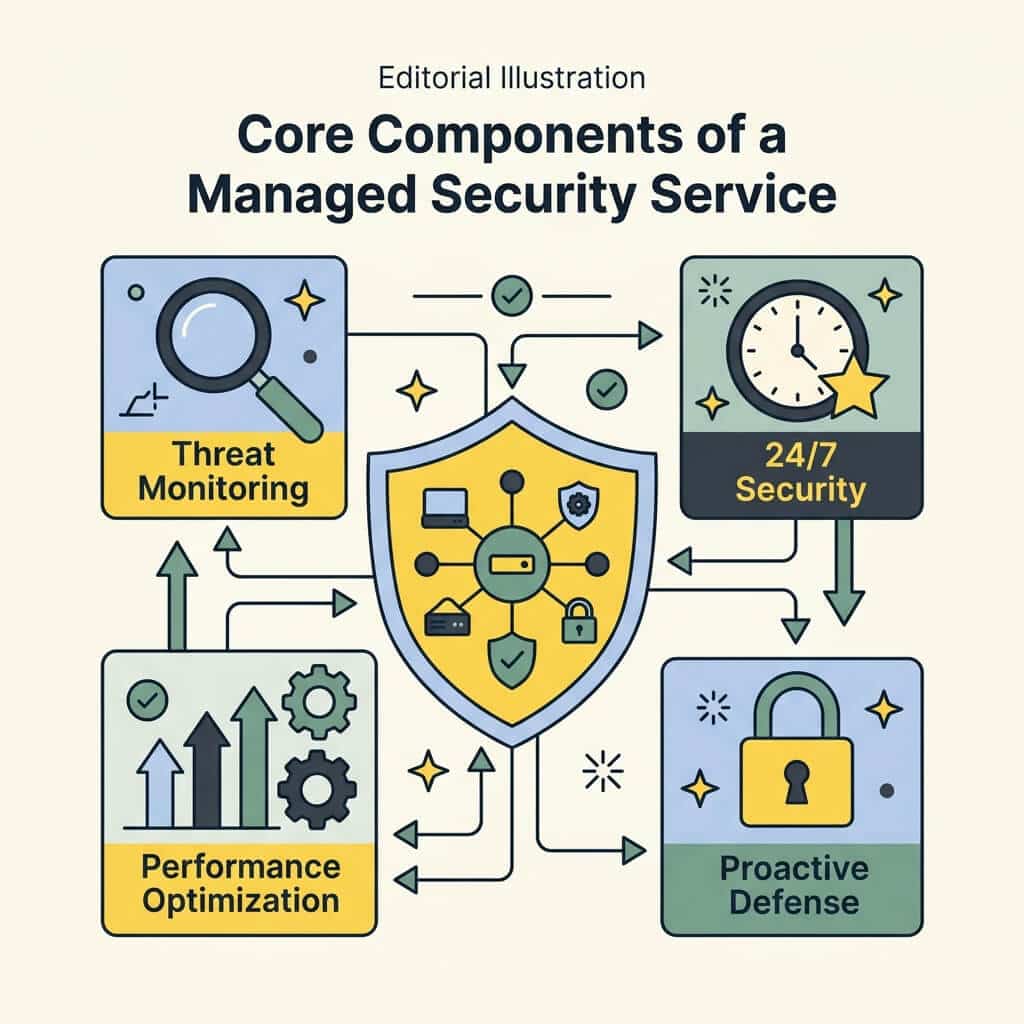
Not all managed security services are identical. However, most SMB-focused offerings include several core components that work together to detect and contain threats. Understanding these components helps you evaluate which service fits your business.
Network Monitoring and Threat Detection
The MSSP deploys monitoring agents on your network and endpoints, collecting logs and telemetry that funnel into a centralized platform. AI-powered analytics scan this data continuously for anomalies: unusual traffic patterns, known malware signatures, credential misuse, data exfiltration attempts, and suspicious behavior. When a pattern matches a known threat or violates your security policies, an alert fires. Human analysts then investigate to confirm whether it's a real threat or a false positive.
Modern managed security uses behavioral analytics in addition to signature-based detection. This means the system learns what "normal" looks like for your organization—which applications typically run, which users typically access which systems—and flags deviations. This catches zero-day attacks and novel malware that don't have known signatures yet.
Endpoint Protection and Malware Defense
Endpoints—laptops, desktops, mobile devices—are the primary target for ransomware, spyware, and data stealers. Managed security includes endpoint protection that runs continuously on each device. This includes malware scanning, behavioral blocking (stopping suspicious executable behavior even before the malware is identified), and exploit prevention. Anti-malware solutions automatically quarantine threats, and the MSSP's team is alerted to investigate and ensure full removal.
Firewall and Network Segmentation Management
A firewall is your first line of defense, but it requires constant tuning. Managed security services monitor firewall logs, manage rule updates, and adjust segmentation as your network evolves. Modern network infrastructure increasingly includes cloud resources, remote workers, and APIs—all requiring intelligent firewall policies. The MSSP handles this complexity so your network remains protected even as it changes.
Backup and Disaster Recovery
Ransomware's primary goal is extortion: encrypt your data and demand payment for the key. Regular, tested backups are your insurance policy. Managed security services often include or coordinate with backup and disaster recovery solutions to ensure your critical data is protected and recoverable. If a ransomware attack succeeds, you can restore from backup without paying the attacker.
Vulnerability Management and Patch Deployment
Every software has vulnerabilities. Attackers scan for unpatched systems because patches are public knowledge—anyone running outdated software becomes a sitting duck. Managed security includes vulnerability scanning to identify unpatched software and security flaws, prioritization of which vulnerabilities matter most, and automated or coordinated patching. Patch management services ensure your systems stay current without breaking critical applications.
Incident Response and Threat Hunting
When a threat is confirmed, managed security's response workflows kick in. The MSSP's team isolates the affected system, collects evidence, removes the malware, and helps you understand what happened and why. For higher-tier services, threat hunters proactively search your network for signs of compromise—attackers who got in but haven't been caught yet. This active hunting catches slow, stealthy intrusions before they cause damage.
| Security Component | Managed Service Approach | In-House IT Team Approach | TechWorks Advantage |
|---|---|---|---|
| Threat Detection | AI + human analysts, 24/7 continuous monitoring | Alerts only during business hours; often missed | TechWorks cyber team monitors 24/7/365 with automated detection and expert escalation |
| Incident Response | Immediate containment; analyst investigation within minutes | Delayed; requires on-call rotation or waiting until business hours | TechWorks responds in minutes, not hours or days |
| Vulnerability Patching | Automated or scheduled; coordinated with MSSP | Manual or ad-hoc; often deprioritized | TechWorks patches proactively; workstations auto-patched, servers coordinated |
| Cost | $3,000–$10,000/month all-inclusive | $200,000+/year salary + tools + training | Starting at $449/month for cyber and network infrastructure with full 24/7 coverage |
| Expertise Required | None; MSSP is the expert | Hiring and retaining security talent | TechWorks manages the talent; SMB just gets the protection |
How Managed Security Services Work in Practice
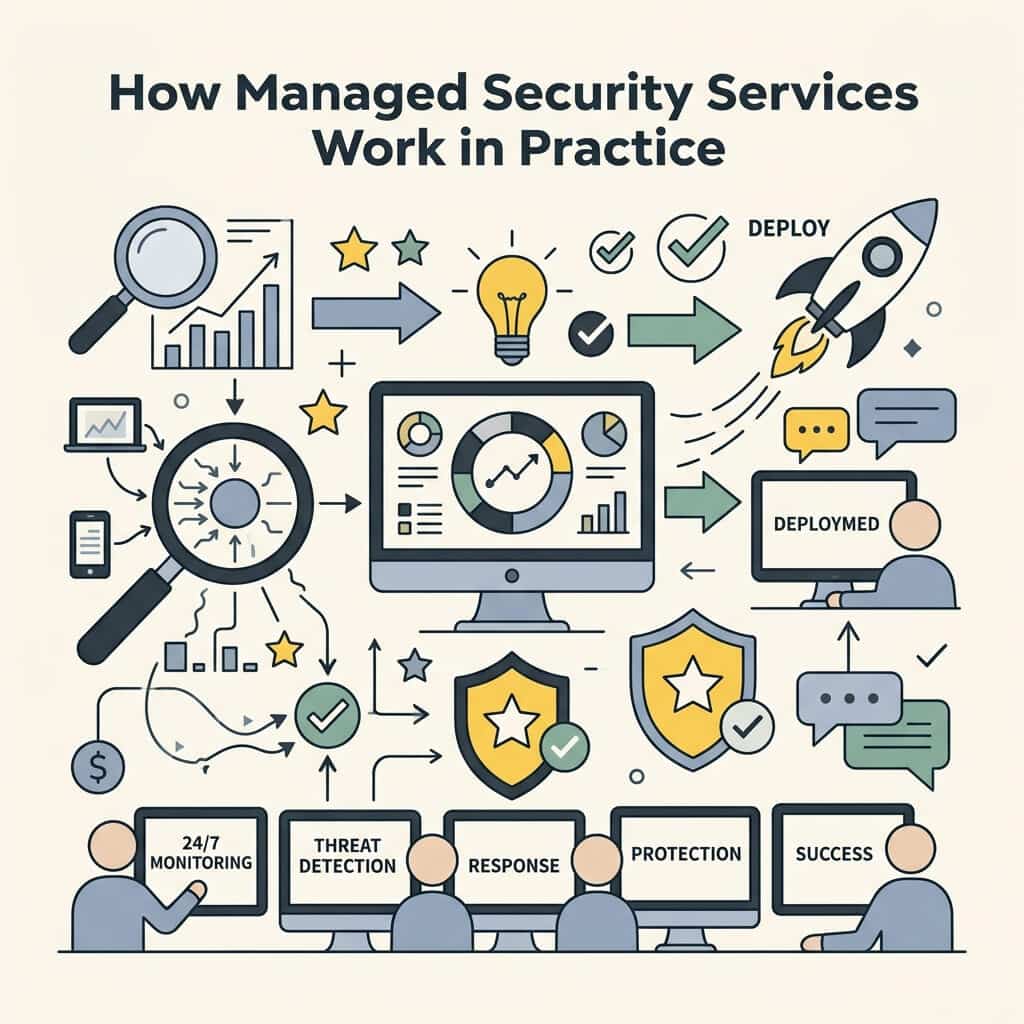
Understanding how managed security operates day-to-day helps you evaluate whether it's the right fit for your organization. The workflow is simple at a high level but sophisticated in execution.
Deployment and Onboarding
When you engage a managed security provider, the first step is discovery. The provider's team learns about your infrastructure: how many users, what systems run on-premise or in the cloud, what applications are critical, what compliance requirements apply. This typically takes 1–2 weeks of interviews and audits. Next, the MSSP deploys monitoring agents to your network, endpoints, and firewalls. This usually happens over 1–2 weeks with minimal disruption. Your team doesn't need to manage the deployment; the MSSP does it. Once agents are in place, the system begins collecting data and baselining normal activity. This baseline phase usually lasts 1–2 weeks to avoid false alarms.
Continuous Monitoring and Alert Generation
After onboarding, the MSSP's SOC monitors your systems continuously. Logs, network traffic, and endpoint telemetry flow into the MSSP's platform where AI models and detection rules scan for threats. When a pattern matches a known attack, violates a policy, or exhibits suspicious behavior, an alert is generated. The alert is assigned a severity level (critical, high, medium, low) based on the threat's potential impact.
Alert Investigation and Triage
Not all alerts are real threats. A user who logs in from a new country after traveling generates an unusual login alert. A backup job that copies large amounts of data triggers a data exfiltration alert. Security analysts review each alert, investigate the context, and determine if it's a real threat or a false positive. This investigation happens quickly—usually within 30 minutes for high-severity alerts. The analyst documents their findings and either closes the alert as benign or escalates it for response.
Incident Response and Containment
When a real threat is confirmed, the incident response process begins. For automated responses, the MSSP's system immediately isolates the affected system, disables compromised accounts, or kills suspicious processes. For manual responses, an analyst calls your organization, describes the threat, and recommends immediate action. Critical incidents—ransomware, data exfiltration, active intrusions—receive immediate phone contact. Less critical issues are documented in detailed reports sent daily or weekly.
Reporting and Strategic Review
Managed security services provide regular reports showing threats detected, incidents handled, vulnerabilities found, and compliance status. Quarterly business reviews let you discuss emerging threats, adjust policies, and plan security improvements. This closes the loop: continuous monitoring feeds insights that inform strategic decisions about your security posture.
Implementation Timeline and Realistic Expectations
Many SMBs assume managed security requires months of implementation and extensive internal resources. In practice, the timeline is much shorter and doesn't demand much from your team.
Week 1–2: Discovery and Assessment
The MSSP meets with your IT leadership and key stakeholders to understand your environment, business requirements, and compliance needs. This is information gathering; minimal technical work happens yet. Your role is to answer questions and provide documentation about your systems and security policies.
Discovery phase activities:
- Inventory of all hardware, software, and cloud systems
- Documentation of current security tools and processes
- Review of compliance requirements and industry regulations
- Identification of critical business systems and data
- Assessment of network architecture and remote access points
Week 2–3: Deployment Preparation
The MSSP determines which agents and tools need to be deployed, develops a deployment plan, and coordinates timing to minimize disruption. Your team doesn't do the technical work; the MSSP coordinates directly with your IT provider or handles it independently. Deployment usually happens overnight or during a maintenance window when the fewest people use systems.
Week 3–4: Agent Deployment and Baselining
Monitoring agents install on workstations, servers, and network devices. The system begins collecting data and learning what "normal" looks like for your organization. During this week, you may see alerts for legitimate activity the system hasn't yet learned to recognize. Analysts suppress these as false positives and refine detection rules. By the end of week 4, the system is in steady state and begins detecting real threats with high confidence.
Ongoing Operations
Once operational, you'll receive daily summaries of alerts and incidents, monthly reports on security metrics and trends, and quarterly business reviews to discuss findings and plan improvements. Your effort is minimal: you're not monitoring anything yourself. You're receiving expert analysis and responding to real threats when the MSSP escalates them. For most SMBs, this means 1–2 hours per week of attention to security matters, down from the 10–20+ hours required if you had an in-house team.
Managed Security Services vs. Traditional MSP Cybersecurity Offerings
Many managed IT service providers (MSPs) offer cybersecurity as an add-on to their traditional IT support. These offerings vary widely in sophistication and 24/7 monitoring capability. Understanding the difference between a traditional MSP's cyber offering and a dedicated managed security provider is important.
Traditional MSP Cybersecurity
Typical MSP cyber offerings include endpoint antivirus, basic firewall management, and vulnerability scanning. These are valuable but limited. An MSP is generalist—they manage servers, networks, helpdesk, and cloud—so cybersecurity is one of many responsibilities. They may not staff security experts around the clock. Their SOC (if they have one) monitors security among other IT issues. This model works for basic protection but doesn't catch advanced threats or match the expertise of a dedicated security provider.
Dedicated MSSP Services
A dedicated MSSP specializes exclusively in security. Their analysts are security experts, not generalists managing multiple domains. They run a SOC staffed around the clock with security professionals. They invest deeply in threat intelligence, AI models, and response automation. They hunt threats proactively, not just react to alerts. Their security culture is different: security is not a side responsibility; it's the entire mission.
For SMBs, the question is: what does your risk profile demand? If you're a small retailer with no sensitive customer data, basic MSP cyber protection may suffice. If you handle payment cards, health records, financial data, or are in a regulated industry, dedicated MSSP services are worth the investment.
TechWorks offers comprehensive cyber security and anti-virus solutions integrated with IT infrastructure management, combining managed IT support with 24/7 security monitoring so your business gets coordinated protection across all systems.
Conclusion
24/7 managed security services transform how SMBs protect themselves against cyber threats. By outsourcing threat detection and incident response to experts operating around the clock, SMBs gain access to enterprise-grade security without the cost of hiring full-time specialists. The numbers tell the story: threats detected in hours instead of months, breach costs cut by tens of millions of dollars, and compliance requirements met automatically.
The average SMB breach costs $4.8 million and forces 60% of affected businesses to close within six months. Managed security reduces that risk dramatically. SMBs that implement managed services see 24/7 threat detection versus the 277-day discovery time of internal teams. The ROI is immediate and measurable.
If your business handles sensitive data, operates in a regulated industry, or simply can't risk the damage of a major breach, managed security is not a luxury—it's a necessary investment. The right provider becomes an extension of your team, handling threats you'd never catch alone while you focus on running your business. TechWorks delivers exactly this outcome: 24/7 security monitoring, expert threat response, and compliance support built specifically for SMBs. Get started with a security assessment to understand your current risk and how managed security can protect your business.